Category Archives: Uncategorized

Trump and the Crisis of the Republican Party

In a previous post, I outlined the ways in which Donald Trump’s policy positions deviate from those of central Republican Party stakeholders. An important question, then, is how a figure such as Trump managed to take over a major American political party? Adding to the puzzle is that he did so while raising and spending little money, without significant organization, with no experience in public office and without a serious team of policy advisors.

One set of factors concerns the rules of the Republican nomination contest. Traditionally, candidates who do poorly in the early nominating contests lose the ability to raise the money necessary to continue. This serves to narrow the field. The Supreme Court’s Citizens United ruling, however, made it possible for less viable candidates to remain in the race by finding one or more deep-pocketed sugardaddies. In the recent nominating contest, the establishment candidates – Jeb Bush, Marco Rubio, John Kasich – had the money to stay in the race despite poor performance. This divided the moderate Republican vote, allowing Trump to squeak out victories in a number of close contests.

Also, the GOP adopted winner-take-all rules in hopes of advantaging frontrunners. A candidate who won only a plurality of the primary vote in a state – perhaps only one third in a crowded field – was awarded 100% of the convention delegates.

The establishment candidates focused their fire on one another rather than Trump, in hopes of eliminating rivals for the position of Trump’s last remaining opponent. This allowed Trump to remain relatively unscathed in the early contests while his competitors weakened one another. Yet the field failed to narrow until deep into the spring. Trump also did especially well in states with open primaries, where he racked up votes by independents. These factors allowed Trump to pile up victories and delegates despite seldom winning an outright majority of votes in any given state.

While Trump was able to take advantage of these rules of the game in unexpected ways, the problems for establishment Republicans go much deeper. Americans are increasingly choosing to live in areas where neighbors share their partisan and ideological inclinations. Moreover, Republican-dominated state legislatures have gerrymandered congressional districts to advantage Republican candidates. They have also used voter suppression laws to disenfranchise Democratic-leaning groups. There are, as a result, fewer states and congressional districts featuring competitive general election contests. In heavily Republican areas, moderate GOP incumbents face a much stronger challenge from more conservative candidates in the primary than from the Democratic candidate in the general election. A number of mainstream Republican Senators and Representatives – including House Majority Leader Eric Cantor – were swept from office in 2014 by Tea Party challengers within their own party.

While establishment Republicans retain the ability to raise money from business supporters, they have increasingly lost control of the party’s base, which has allowed insurgent forces – whether Tea Partiers or Trump’s populist-nationalist supporters – to challenge the establishment.

Three factions have jockeyed for power within the modern Republican Party in recent decades: neo-conservatives, social conservatives and business conservatives. All three have been weakened or discredited. Neo-conservatives (e.g., George W. Bush, John McCain, etc.) led the country into two costly and unwinnable wars (Afghanistan and Iraq) that have proven unpopular even among many Republicans. Social conservatives (Mike Huckabee, Ben Carson, Rick Santorum, etc.) have lost clout as increasingly fewer young American identify as fundamentalist/evangelical Christians or align with social conservatives on lifestyle issues. Meanwhile, the anti-regulatory, pro-Wall St. stance of business conservatives (Jeb Bush, Marco Rubio, John Kasich) has been discredited by the financial crisis and its lingering effects.

In short, a hollowed-out Republican Party is a shell of its former self. At the national level, the GOP has no ideological center. It has instead become a regional party focused on the South and the interior West. Demographically, the party rests upon a shrinking base of white males. It continues to enjoy built-in advantages in many states and localities due to years of gerrymandering and voter suppression laws. It also does relatively well during mid-term elections when turnout is lower. But changing demographics, ideological incoherence and successful court challenges to voter ID laws suggest that the Republican Party is no longer viable in presidential campaigns and will, over time, weaken at the congressional and state levels.

The ease with which Trump brushed aside the Republican establishment is evidence of the party’s underlying weakness. Trump’s candidacy itself has further divided and undermined the party. Some party leaders have withheld support from Trump, even exploring the possibility of cohering around an independent candidate for president or backing Libertarian candidate Gary Johnson. Others have endorsed Trump in a reluctant and pro-forma manner, while being forced to disavow his inflammatory language on a weekly and sometimes daily basis. A few – mostly marginal figures (e.g., Newt Gingrich) – have jumped on the Trump bandwagon.

To be sure, some aspects of Trump’s success arise from idiosyncratic factors, such as Trump’s celebrity, his financial independence, his skill at attracting media attention and his instinct for tapping popular sentiments – especially anti-elite and nationalist feelings – that establishment candidates have been slow to exploit.

Nevertheless, Trump’s nomination signals a grave crisis for the Republican Party. His undisciplined campaign itself and the prospect of a crushing defeat to a weak and unpopular Democratic candidate in November will only add to the GOP’s woes.

Given that the structure of the American political and electoral systems strongly favor two dominant parties, it seems likely that the Republican Party will survive in some form, but only after a period of bruising internal combat among competing factions. Trump himself is unlikely to remain a major player after November, but the populist, nationalist constituency to whom he appealed will remain available to future candidates.

As the Republican Party seeks to redefine itself through this sorting-out process, two factors are worth considering. First, Ronald Reagan, who led Republicans out of the wilderness and into the center of American politics offered a sunny, optimistic charisma. The contrast with the dark, angry emotions represented by Trump and the Tea Partiers could not be greater. There is no question that anger can be a powerful motivator. But it cannot provide the basis for a sustainable governing majority. The tone and image of the party must change if is to broaden its appeal.

Second, the Reagan coalition was built upon a coherent intellectual foundation focused upon deregulation, supply side economics, free trade and a strong military. This core program emerged from a two decade process of conceptual work among policy intellectuals who debated ideas within a constellation of think tanks, magazines and academic programs. With the Reagan consensus now shattered, a similar process of updating the intellectual foundations of the Republican brand must now take place before the party can hope to rise again.

Once a coherent and broadly appealing intellectual message is available, a charismatic and skilled presidential candidate must emerge who can articulate these ideas and provide a rallying point for the various constituencies to whom the message is directed.

This process of reconstructing the basis for a nationally competitive Republican Party is likely to unfold over several election cycles. During the interim, the Democratic Party will have the opportunity to consolidate its national-level dominance for a generation or more. Much will depend, however, upon whether the Democrats can manage their own internal rifts. Under Bill Clinton, the Democrats became a party of interest groups held together by transactional politics. The emergence of a much more ideological left-wing of the party as represented by Bernie Sanders and Elizabeth Warren serves as a challenge to the Clinton formula. If the Democrats manage to win both the House and the Senate in November, along with the presidency, then the most significant political cleavages that shape the coming four years could center around the struggle not between conservatives and liberals or Republicans and Democrats, but between ideological and transactional elements of the Democratic Party.

Political parties are constellations of interests and ideas. At some moments in history, these constellations cohere and consolidate. At others, they splinter and break apart. After a period of relative coherence beginning with the Reagan presidency, the Republican Party has entered an era of internal division and redefinition. Trump is but a symptom of the GOP’s deeper maladies.


Leave a comment

Filed under Uncategorized

The American Working Class and Donald Trump

In the 1960s, American workers constituted a labor aristocracy on a global scale. The United States led all other countries in global manufacturing. Productivity levels and thus wages were higher in the US than in other leading economies. Even without a high school degree, male workers could make a middle-class income in an auto or steel plant. Income inequality was at an historic low after half a century of decline and social mobility was high. Roughly one in three workers was a union member.

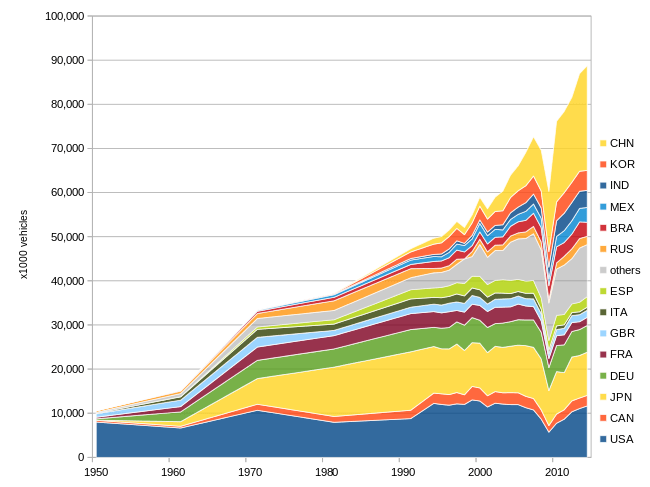
How things have changed. Consider, for instance, the automobile industry. As the chart below illustrates, US auto production dwarfed that of any other country in the 1950s and 1960s. Today, however, US-based auto production remains about where it was six decades ago while production elsewhere around the globe has skyrocketed. China now produces twice as many vehicles as the United States. It is similar in other industries.

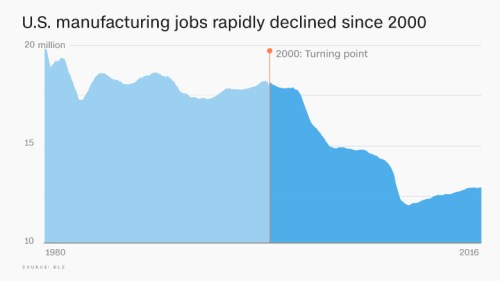
Once lucrative manufacturing jobs have disappeared not only due to the shift of production overseas but also due to automation and rising worker productivity.

Yet since the 1970s, productivity gains have been captured not by American workers, but by the owners of capital.
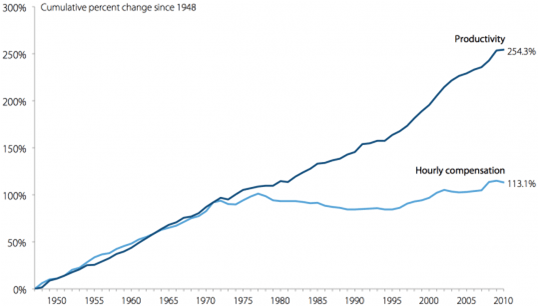
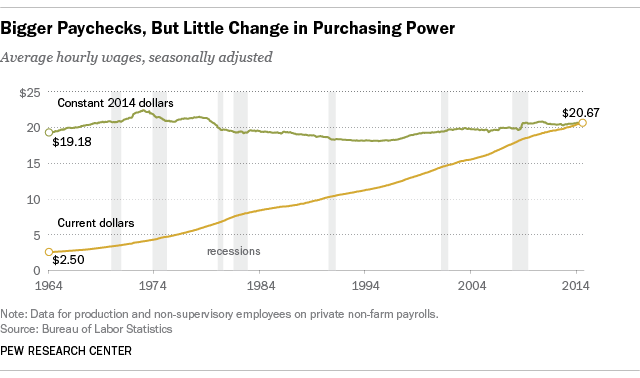
Real wages and income have therefore stagnated for most workers.

This is especially true for men. While female income has continued to rise – thus gradually reducing the gender pay gap – average male earnings have actually declined over the past half century.

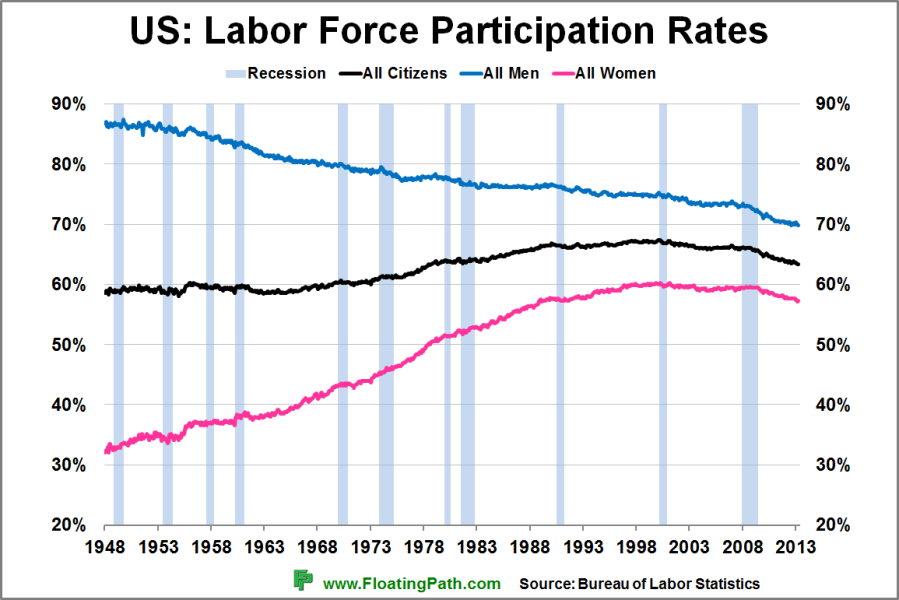
Changes in the fortunes of men and women are also evident in trends in labor force participation. Fewer men are entering the workforce while the opposite is true for women.

Meanwhile, virtually all of the income gains of recent decades have gone to those at the top of the income distribution, thus widening the inequality gap and reducing social mobility.
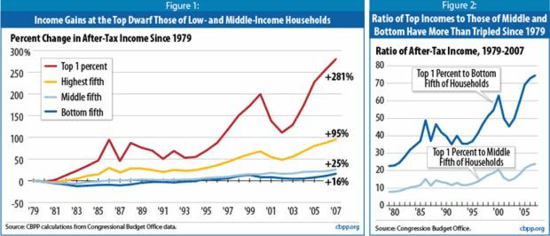
The chart below shows that the income of males without college degrees has fallen sharply over the past quarter century while the biggest winners have been women with a bachelor’s degree or higher.

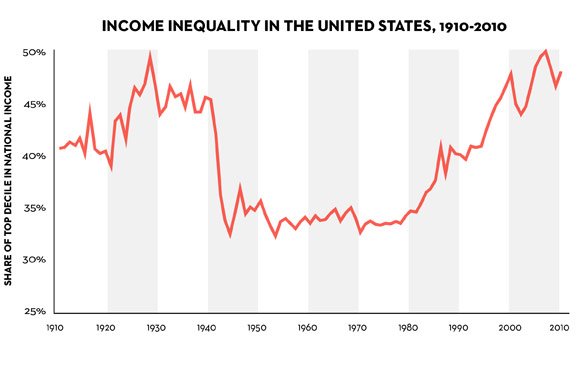
The current level of income inequality rivals that of the 1920s and far exceeds the relatively equitable distribution of the middle of the 20th century.

The declining share of income that goes to the middle class has been closely correlated with a declining union membership rate.

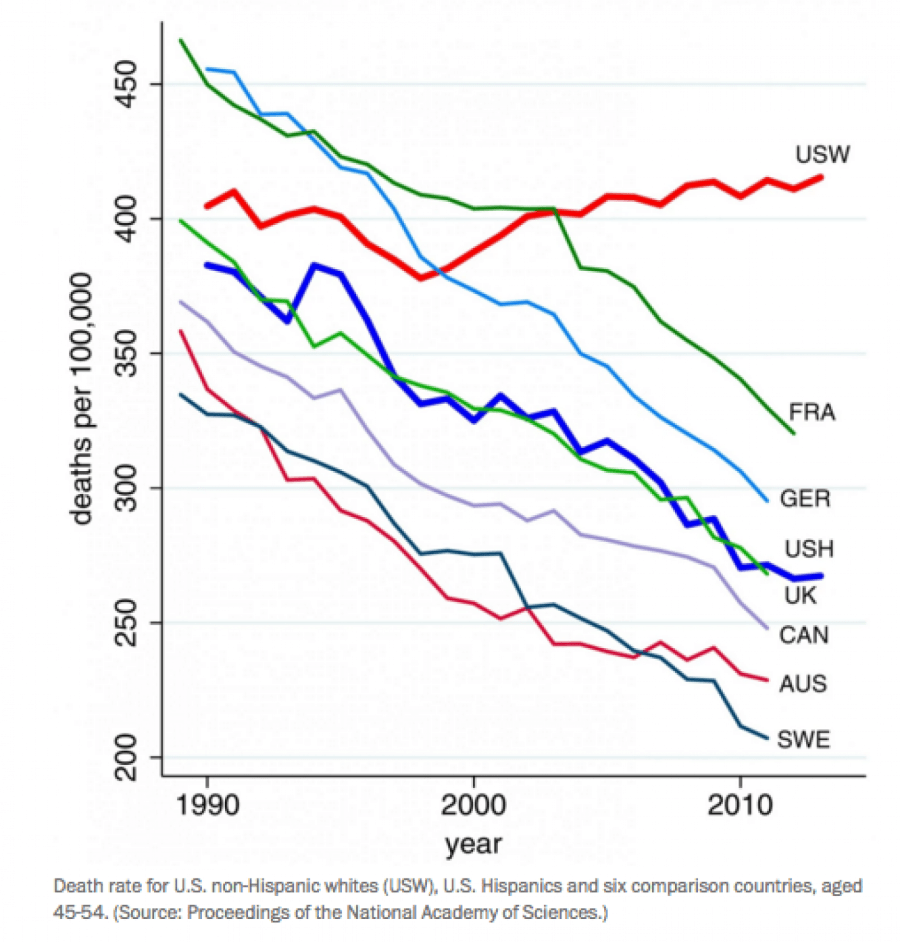
In a sign of growing social distress, the death rate among middle-aged white males in the US has risen over the past decade, in contrast with the usual pattern of falling death rates (see red line in chart below).

All of these trends help us understand the success of Donald Trump. Trump draws his strongest support among middle-aged white males who are less affluent and less educated – precisely those Americans who have suffered a loss of relative economic and social status over the past half century. This same demographic group was, relatively speaking, prospering in the 1950s and 1960s. But the manufacturing jobs that supported this prosperity have either moved overseas (Chinese imports alone may have cost 2.4 million American jobs between 1999 and 2011) or been eliminated through productivity-enhancing technological change. The latter trend might have led to rising incomes for those who managed to maintain jobs in the manufacturing sector, except that the returns to capital have risen sharply relative to the returns to labor. At the bottom of the income distribution, an influx of low-skilled immigrants over the past several decades combined with the failure of minimum wage rates to keep up with inflation have depressed wages for the least educated. What few gains workers have been able to eek out have gone mostly to women, who have joined the workforce in higher numbers while also managing modest improvements in compensation (though the gender wage gap nonetheless persists). Globalization has also allowed capital to seek out cheaper labor and higher returns in developing regions, thus undermining the bargaining position of North American and European workers. As a result, private sector unions have practically disappeared in the US. Without unions to provide some direction for working class discontent, a populist figure such as Donald Trump can harness this anger by bashing immigrants and imports.
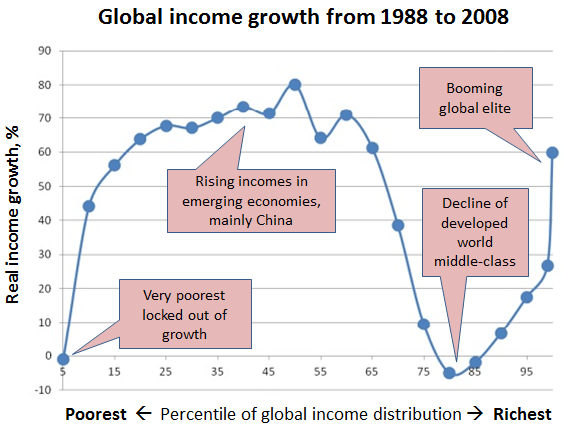
On a global scale, the following chart situates the American working class within the global income distribution. The income of those at the top – the owners of capital – has grown rapidly as globalization has provided capital with access to cheap labor outside of Europe and North America. Incomes have also grown rapidly in emerging economies – such as China – where previously impoverished workers have gained access to the kind of factory jobs that Americans enjoyed in decades past. The group that has experienced no gains are the workers of North America and Europe. While this group remains well off in both absolute and relative terms, it has fallen behind, over time, in comparison with the highly educated global elite and the rising working class of the developing world.

The brand of populism and nativism that Trump offers working class American males provides no real solutions to the downward mobility that this group has experienced. But until mainstream politicians and parties address the real grievances of American workers, one can expect more disruptive politics.

1 Comment

Filed under Uncategorized

The Political Economy of Trump

An unprecedented number of GOP establishment figures have either renounced (e.g., Jeb Bush, Mitt Romney) their party’s presumptive nominee, offered painfully reluctant endorsements (e.g., Mitch McConnell, Paul Ryan, Marco Rubio) or remained on the sidelines (e.g., John Kasich). Criticism of Donald Trump by Republic stalwarts has often focused on his racist and intolerant statements about Muslims, Hispanics and blacks.

But it is not Trump’s racism that rankles the Republican establishment. After all, congressional Republicans opposed George W. Bush’s plan for immigration reform and rejected extension of the Voting Rights Act while at the state level Republican-controlled legislatures have passed voter identification laws that represent transparent efforts to suppress the minority vote.

So while it is politically expedient to distance themselves from Trump’s crude rants, it is not racial sensitivity that is driving the discomfort that Republican insiders feel about Donald Trump. Instead, the problem lies with Trump’s preferred policies toward trade, taxes and spending and debt. In short, Trump is out of sync with the corporate and investor interests that lie at the center of the Republican coalition.

The GOP brand is associated with lower taxes for the wealthy, smaller government, freer trade and tight money. These policies fit the preferences of corporate political backers such as the Koch brothers.

Trump, of course, is a businessman himself. But as a real estate developer, Trump’s interests differ from those of Wall St. or big manufacturers. Unlike bankers or hedge fund managers, developers are borrowers, not creditors. In contrast with manufacturing firms that export goods, real estate lies in the non-tradable sector of the economy. While many businesses and wealthy individuals prefer low taxes, developers of office buildings, hotels and casinos benefit from the public goods created through government spending. Trump’s business interests and his worldview are thus distinct from the business groups that have long held sway within the Republican Party.

Consider money. On Federal Reserve policy, bankers and creditors prefer tight monetary policies that push up interest rates, keep inflation low and strengthen the dollar. Debtors, on the other hand, prefer easy money, low interest rates and moderate inflation, which allows borrowers to pay back loans with cheaper money.

Trump has declared that “I am the king of debt. I love debt.” In contrast with Paul Ryan, Ted Cruz and John Kasich, all of whom have castigated Fed Chair Janet Yellen for keeping interest rates low, Trump has mostly offered praise for Yellen and indicated sympathy for a loose monetary policy.

Indeed, Trump has suggested that this would be a good time for the Federal government to borrow money to fund infrastructure spending because interest rates are so low. More controversially, he indicated that, as President, he would be prepared to cut the Federal debt by negotiating reduced payments to holders of Treasury bills. This is, of course, how Trump himself escaped debt obligations numerous times under the cover of bankruptcy proceedings. Even the suggestion that the United States government might renege on some of its obligations to creditors set off alarm bells among investors who have large holdings of Federal bonds.

Trump’s views on taxes and the size of government are also worrying to Republican leaders and their business friends. While Trump proposes reduced income tax rates – a perennial Republican mantra – he has waffled on whether the wealthy might have to pay more in taxes. In sharp contrast with Paul Ryan, Trump rejects cuts to social security and Medicare. He also calls for increased military spending and, as mentioned above, growing public infrastructure investment. All of Trump’s proposed spending cuts would focus, implausibly, on the relatively small portion of the Federal budget devoted to discretionary spending. Combining Trump’s various tax and spending pledges, the Tax Policy Center estimates that his proposals would produce falling revenues and ballooning budget deficits. In short, Trump is a fiscal Keynesian.

Perhaps the most glaring area where Trump defies Republican orthodoxy is international trade. Calling NAFTA a “disaster,” Trump has promised: “We will either renegotiate it, or we will break it.” Similarly, Trump has called the TransPacific Partnership agreement “insanity.”

Trump’s own business investments lie mostly in the domestic, non-tradable sector of the economy. Trade and foreign investment are tangential to Trump’s principal businesses. This frees Trump to make a protectionist pitch appealing to working class Americans who feel threatened by imports (and immigration). This places him closer to the interests of a significant, but otherwise poorly represented, segment of the Republican base whose economic interests are misaligned with those of the party’s globalized business elite funders.

Among Republicans, a voter’s position on trade is a powerful indicator of their attitude toward Trump’s presidential bid. The force of Trump’s anti-trade appeal is evident in the finding that 89 of the 100 US counties most exposed to Chinese imports voted for Trump in the Republican primaries, while Trump won only 28 of the 100 countries least exposed to Chinese imports.

A recent PEW survey found that while 51% of Americans overall view trade deals as good for the United States, two thirds of registered Republicans who support Donald Trump consider trade deals bad for the country. Democrats are now more supportive of free trade than Republicans, a reversal of patterns dating back to the 1970s. Republican pro-free trade politicians and business must now confront the possibility that Trump has shifted the party’s center of gravity toward a protectionist stance among the base.

Trump voters vary from traditional Republicans in significant ways, as is evident from recent PEW polling.

Trump supporters differ from other GOP voters on immigration, other issues

Donald Trump’s fusion of nationalism, protectionism and right-wing populism has tapped a politically rich vein that will be available for others to mine long after Trump’s own presidential ambitions have been squashed. The political economy of Trump represents a potent challenge to long-standing political alignments, especially, though not exclusively, within the Republican Party.


2 Comments

Filed under Uncategorized

Current Echoes of Jimmy Carter’s Diplomatic Legacy

(appeared in US News and World Report, October 5, 2015: http://www.usnews.com/opinion/blogs/world-report/2015/10/05/obamas-jimmy-carter-like-foreign-policies-are-his-most-successful)

Barack Obama’s critics have often invoked unflattering comparisons between his foreign policy record and former President Jimmy Carter’s perceived failures. In reality, however, Carter’s diplomatic achievements while in office stand among the most impressive of any American president. As the sad news of Carter’s cancer diagnosis prompts reflection upon his life’s work, the recent nuclear agreement with Iran should remind us of the most important legacy of Carter’s presidency: the lesson that diplomacy works. After all, Obama’s foreign policies have met with the greatest success precisely where he has most closely emulated Carter.

Both presidents rode the White House on a wave of popular revulsion at the costs and failures associated with recent or ongoing wars—Vietnam in Carter’s case; Iraq and Afghanistan in Obama’s case. Both understood that any exit from America’s debilitating and seemingly unending record of military quagmires required a foreign policy that dispensed with threat-mongering and placed diplomacy—even with adversaries—at its center.

Carter and Obama each faced the challenge of developing proportional responses to what had previously been treated as Manichean struggles; against communism in Carter’s era and against terrorism during Obama’s era. Each president sought to make room on the foreign policy agenda for a broader range of issues that engaged American values and interests, including, in both cases, human rights, arms proliferation, energy and relations with emerging powers.

Both stressed diplomacy as an alternative to military intervention and unending conflict. Neither relied upon negotiation alone and both encountered problems that could not ultimately be resolved at the bargaining table. Yet each found success in tackling conflicts long considered irresolvable.

Carter’s record is the more impressive. The SALT II agreement with the Soviet Union capped a dangerous and costly nuclear arms race (while never ratified by the United States Senate, both countries independently abided by the terms of the accord). The Panama Canal Treaty removed potential threats to the Canal’s security, while eliminating a constant irritant in U.S. relations with Latin America. The full normalization of relations with China set the stage for China’s growing integration with the existing global political and economic order over the past 35 years. The Camp David Accords removed Egypt and Jordan as military threats to Israel’s security and the transition to majority black-rule in Zimbabwe, brokered by the United States and Great Britain, brought to an end to a bloody civil war there. The successful conclusion of the Tokyo Round trade negotiations sustained progress toward a more open global economy. It is difficult to think of another president who used diplomacy to better effect in serving major American interests.

In Obama’s case, diplomacy has enabled destruction of Syria’s stockpile of chemical weapons while blocking Iran’s path to a nuclear weapon for at least 15 years. The opening to Cuba creates new opportunities for the Cuban people while enhancing America’s image across Latin America. A successful conclusion of the upcoming global climate change negotiations appears more likely in the wake of the recent joint U.S.-China declaration setting national goals for reducing greenhouse gas emissions. The recently completed Trans-Pacific Partnership trade agreement caps an already solid record of diplomatic accomplishments during the Obama years.

For both Carter and Obama, the bigger obstacles to diplomacy often arose at home rather than abroad. Carter faced massive, well organized and heavily funded campaigns against both the Panama Canal and SALT II treaties, as well as a drum-beat of right-wing accusations that his policies left America unprepared to meet a (mostly mythical) Soviet military buildup. The Iranian revolution and the ensuring hostage crisis sullied Carter’s reputation and may have cost him his presidency, despite the fact that the hostages were safely returned.

Obama has likewise faced heavy domestic constraints, including the Senate’s rejection of his proposed cap-and-trade energy legislation and opposition to the Iranian nuclear accord.

Diplomacy, of course, cannot solve all problems. But it served American interests remarkably well during Jimmy Carter’s brief presidency. All the more puzzling then that our memories of the Carter years are so distorted and his diplomatic achievements have gone so undervalued.

It is to Obama’s credit that he has in important ways drawn upon the positive lessons of Carter’s foreign policy legacy. And as the clock ticks down on Carter’s own remarkable life, it is well that we set aside the unkind myths that have obscured his accomplishments in office and give credit to a diplomatic groundbreaker.

David Skidmore is a Professor of Political Science at Drake University in Des Moines, Iowa and author of Reversing Course: Carter’s Foreign Policy, Domestic Politics and the Failure of Reform, Vanderbilt University Press, 1996.

1 Comment

Filed under Uncategorized

Too Many Pigs at the Trough

Chinese President Xi Jinping has made the fight against official corruption a cornerstone of his reign. The Chinese Communist Party disciplined 300,000 officials for corruption in 2015. Hundreds of high-level leaders have been caught up by the campaign.

Among the Chinese people, Xi is enormously popular and his anti-corruption efforts have won widespread applause. Yet Xi’s crackdown has little to do with good government. In The Dictator’s Handbook, Bueno de Mesquito and Alastair Smith point out that dictators survive by channeling private rewards to a coalition of supporters who are essential to maintaining power. Over time, the number of individuals attached to the ruling coalition tends to grow, as does the price coalition members demand for support. We might call this the “too many pigs at the trough” problem.

This may be sustainable if the economy is rapidly growing, but becomes more problematic once growth slows. Because the rents extracted by corrupt officials in fact serve as dead weight from an economic perspective, corruption itself can become a source of worsening economic performance. The costs of paying off a bloated coalition of greedy supporters are considerable: a reduced take for the dictator himself, lagging revenue growth and declining popular legitimacy, the latter necessitating increasingly costly repression.

All of this explains why newly installed leaders move quickly to cull the number of pigs at the trough. By retargeting private rewards only to those whose support is truly essential and reducing the size of payoffs to the minimum necessary to avert defection, the dictator thereby shores up his power position with a smaller and more manageable ruling coalition. Of course, culling the herd means more than simply cutting rewards to non-essential coalition members. They must be jailed or otherwise rendered incapable of retaliating. Ruthlessness toward those unlucky enough to be targeted also sends a salutary message to the remaining essentials should the latter have ideas about combining against the dictator.

Xi’s campaign is reshaping the size and composition of the ruling coalition and the size of the payoffs to remaining members. But as long as China’s political order remains a single party dictatorship, a system for funneling private rewards to member of the ruling coalition will remain essential to its functioning.

Leave a comment

Filed under Uncategorized

Sex Ratio Imbalance and Chinese Economic Reform

China’s economy is choking on overinvestment in infrastructure, construction and heavy industry (such as steel and autos, both of which suffer from overcapacity). Both Chinese and Western economists argue that China needs to shift resources into the service sector, which remains underdeveloped. Indeed, this reallocation of resources is a central plank of China’s own economic reform plans.

Yet implementation has been slow. Why has Beijing been reluctant to close down surplus steel factories, cut off funding for the construction of “ghost cities,” or slow down the expansion of high-speed rail and other expensive infrastructure projects?

While there are no doubt many factors that play into such decisions, there is one that deserves more attention that it has received: China’s leaders fear the consequences of high unemployment among so-called “bare branches” or young, low-status men who lack good marriage prospects.

China has one of the most skewed sex ratios in the world. For the population under age 15, there are roughly 117 males for every 100 females (the natural rate should be no higher than 105-100). This is a result of extreme gender discrimination favoring males. Female fetuses (identified through ultrasound) are aborted. And young girls are more likely to die of illness or neglect.

With so many more men than women, a large number of men will never find marriage partners. Those least likely to marry are low-income, less educated, low status males. These same men are poorly integrated into communities and make up a large proportion of the internal migrant population that relocates from rural areas to cities in search of work. These males are called “bare branches” in China because they represent endpoints on the family tree.

Research by Valerie Hudson and Andrea den Boer establishes that societies with large and growing numbers of bare branches are at risk of rising crime and civil unrest. This is especially true if inadequate employment opportunities are available for unmarried young men.

How does this relate to China’s slowness to carry out economic reform? Males are overrepresented among Chinese factory and construction workers. Indeed, the proportion of female workers in these sectors is actually declining. On the other hand, females make up a disproportionate share of workers in the service sector.

Some economists believe that China’s official unemployment rate understates the true reality. The rate of unemployment is politically sensitive since unemployed workers are more likely to engage in civil unrest and other anti-regime activities. China’s growth model has actually exacerbated the unemployment problem because infrastructure, construction and heavy industry are relatively capital-intensive, meaning that a given level of investment produces fewer jobs than would be the case were the same investment devoted to service sectors (which are relatively labor intensive). In other words, a greater emphasis on services would soak up more labor overall and reduce dangerous levels of unemployment.

The problem, however, is that the gender distribution of unemployment would shift in ways that heighten the risk of unrest, especially during the transitional period. Most of the jobs added as a result of expansion of services would be taken up by women while most of the jobs lost by curtailing investment in construction, infrastructure and heavy industry would be those currently occupied by males – and especially bare branch males.

Rising employment could nevertheless be accompanied by growing civil and political unrest if the proportion of bare branch males among those who remain unemployed also rises. Alongside other factors, this may help explain why Chinese authorities have been slow to implement economic reforms that they themselves acknowledge are needed for the overall health of the Chinese economy.


Leave a comment

Filed under Uncategorized

Rethinking the Inevitability Thesis about Tiananmen Square

Rethinking the Inevitability Thesis about Tiananmen Square .

Leave a comment

Filed under Uncategorized

Brief Comment on Study of Variance in Social Mobility Among U.S. States

A recent study shows that social mobility was never has high in the U.S. as perceived, but, on the other hand, mobility has not declined in most states, contrary to common belief. Instead, declining mobility is concentrated among a cluster of states in the U.S. South. This sort of empirical analysis is crucial to sorting out the realities of social and economic inequality in America and devising effective responses.

For example, one thing the study highlights is that low-income children raised in stable, two-parent households have a better chance of upward social mobility. Marriage rates are low among low-income black households; i.e., many single moms. Some people use such data to condemn young black males as poor fathers. Other data, however, show that a big reason black males are not present is that our radicalized system of mass incarceration ensnares a high percentage of young black males, locking them up for long periods in prison, stunting their educational opportunities, limiting their employment prospects after prison and rendering them unable to sustain stable long-term family commitments. As Michelle Alexander demonstrates, this is not because black males are more likely to commit crimes than their white counterparts at similar socio-economic levels, but because of the discriminatory ways in which drug laws (and sentencing) are used to target minority youth. Ditch the drug war and reform the criminal justice system, and one would see major changes (for the better) in rates of marriage and family stability. Leading to greater social mobility, etc. etc. Finally, politicians are waking up to the need for reforms to the criminal justice system, including sentencing (here, here, here).

Leave a comment

Filed under Uncategorized

Comment about the Greece Crisis

When a big country like Germany deliberately pursues economic policies that discourage domestic consumption and raise savings (which fuel investment in export industries), the result is a large trade surplus. This surplus is NECESSARILY matched by deficits on the part of its’ smaller trading partners, like Greece. Those deficits must be financed, which requires that the deficit countries – again, like Greece – borrow money from those – like Germany – who are running surpluses. Were Greece to have its’ own currency, then that currency would devalue, thus discouraging imports and promoting exports. While not a painless solution, this course would over time correct Greece’s trade deficits and allow it to begin paying back its’ creditors. But since Greece is part of the Eurozone, this is not a possibility. If Germany were to change its’ policies to encourage consumption (including imports) and discourage excessive saving, then this would also allow deficit countries – like Greece – to run trade surpluses that could be used to pay back past debts. Instead, Germany is demanding that Greece adopt harsh austerity policies that will dramatically reduce Greek consumption and restore Greek “competitiveness” via reduced wages. But for Greece to do so without major debt forgiveness and while Germany continues its’ own policies that gave rise to large trade surpluses in the first place is entirely unreasonable and unlikely to solve the problem. Greece is not without blame in the current crisis, but Germany is equally culpable, if not more so. Whenever imbalances in trade produce unsustainable debts, adjustments must be made on the part of both creditor and debtor countries.

This reality is recognized in a recent IMF analysis, which acknowledges that Greece cannot hope to pay back its’ debts even were it to accept every feature of the deal on offer from the EU. The rigid positions taken by Germany and the EU are not based upon sound economic analysis, but are instead all about preferred political outcomes: Merkel and company want to push the left from power in Greece and ensure that big governments and big banks call the shots in Europe rather than elected representatives of the people. The EU’s democratic deficit has never loomed larger than it does today.

Leave a comment

Filed under Uncategorized

International and Domestic Sources of United States Foreign Policy

(Another atypical blog post. A long piece on the underlying sources of U.S. foreign policy)

Over the long term, American foreign Policy has been profoundly influenced by three sets of factors: geography, political culture and state-society relations. The combination of these factors helps to account for America’s tardy emergence as a great power, its unique brand of civic nationalism, the moralistic terms in which the aims of U.S. foreign policy are often cast, the lack of consistency in American diplomacy and the hesitation the United States has often shown about accepting or adhering to multilateral commitments.

Political Geography

Geography may not be (manifest) destiny, but geographic realities do set the parameters within which a nation’s foreign policy is formulated. This is certainly true in the case of U.S. foreign policy. The role of geography has been conditioned by the relative power of the United States and the degree of external threat, producing varying policy outcomes at different points in U.S. history.

For example, geography helps to account for America’s late emergence as a great power. The relative geographic remove of the United States from other great powers permitted its leaders to pursue isolationist policies for more than a century after the founding of the republic. Surrounded by oceans to the east and west and less powerful neighbors to the north and south, the United States enjoyed a position of relative safety. The insecurities that drove other powers toward conflict with one another were mostly absent in the case of the United States. Moreover, while the nineteenth century witnessed the establishment of far-flung overseas empires by European states, the United States was instead preoccupied with westward expansion across the North American continent. This further limited America’s interest in adventures beyond its immediate neighborhood. The most ambitious external policy pursued during this period was the Monroe Doctrine, which sought to limit European influence within the Western Hemisphere.

By the first half of the twentieth century, America’s size, population and economic resources positioned it as a potential leading power. Yet policy-makers were largely content to pursue a strategy of offshore balancing. Only when territorial expansion by aggressive powers threatened to unify the resources of Europe or Asia under the control of single states did American leaders perceive sufficient threat to commit the United States to major military engagements abroad, as during World War I and World War II (Mearshiemer, 2003). Geographic isolation meant that the United States possessed the resource attributes of a great power well before it chose to use these capabilities to influence the structure of world politics.

These circumstances changed after World War II. The Soviet Union possessed the potential, if unchecked, to dominate both Europe and East Asia. With the development of nuclear weapons, moreover, geographic isolation no longer served to insure the security of the U.S. homeland. As a result, the U.S. abandoned its traditional reserve about exercising international leadership and sought to organize a broad array of alliances and institutions toward the goal of containing Soviet power around the world.

Geography has resurfaced as an important factor in the post-Cold War period. Now geography helps to explain why the end of the bipolar Cold War international system has not led to hard balancing by other states against unipolar American power. The geographic remoteness of American power – especially the buffer provided by the Pacific and Atlantic oceans – has served to reassure other states against the possibility of territorial aggrandizement by the United States. Instead, the states of Europe, Asia, the Middle East and Africa perceive greater threats arising from nearby rivals than from the distant, even if potent, military power of the United States. This has not prevented anti-Americanism from taking other forms, such as terrorism or soft balancing. But it has meant that the United States faces little prospect of traditional military balancing coalitions forming as checks to American power (Brooks and Wohlforth, 2002; Walt, 2006).

Political Culture

The American Creed, built upon individual liberty, limited government and democratic politics among other things, lies at the center of American political culture. In a country of immigrants, the Creed serves as a form of civic nationalism, as distinguished from nationalisms based upon ethnicity, religion or place (Pei, 2003; Leiven, 2004). Louis Hartz (1991) notes the “universality of the liberal idea” in America, where liberalism did not vie with competing ideologies and identities as in Europe. The universalistic character of America’s national identity has infused the rhetoric of U.S. foreign policy with a pervasive moralism (Osgood, 1961; Packenham, 1973; Wills, 1973; Hofstadter, 1989). The tenets of the American Creed applied not just to a particular people or place, but could be exported to reform the institutions and cultures of other societies. In the early years after America won its independence from Great Britain, the United States was thought to serve as a “shining city upon the hill” – an exemplar from which others might learn. By the twentieth century, America’s growing power allowed its leaders to embrace a more crusading approach to spreading American ideals, as epitomized by Woodrow Wilson’s zeal for “making the world safe for democracy (Baritz, 1986).”

America’s political culture of civic nationalism has had two main effects. First, Americans have difficulty understanding the power and meaning of ethnic nationalism in other societies (Pei, 2003; Muller, 2008). While the “melting pot” metaphor may be overly simplistic, the United States has nonetheless accommodated recurrent streams of immigration with relative success. Perhaps for this very reason, overly optimistic expectations that American values and institutions could be easily transplanted abroad have been repeatedly frustrated by nationalist backlash against American efforts to remold other societies. Commenting on the uniformity of American political culture and the myopia this produces when dealing with the rest of the world, Louis Hartz (1991: 19) asked “whether American liberalism can acquire through external experience that sense of relativity, that spark of philosophy which European liberalism acquired through an internal experience of social diversity and social conflict.”

Second, many around the world have looked to the United States as a model of freedom and democracy. The dissolution of the Soviet empire, for example, was the product not only of internal strains but also of the attraction that the West in general and the United States in particular held for those within the communist world who longed for greater freedom and prosperity. Yet the moralistic rhetoric that often surrounds American foreign policy brings charges of hypocrisy abroad when American behavior, influenced by national interests at odds with proclaimed principles, inevitably departs from or even contradicts noble proclamations of U.S. intent.

State-Society Relations

Another important consequence of American liberalism has been the survival of a set of political institutions designed to disperse rather than concentrate political power and authority (Huntington, 1982, Katzenstein, 1978; Krasner, 1978; Risse-Kappen, 1993). In Europe, war and the threat of war led to the development of relatively strong, centralized states. By contrast, the deep-seated nature of American liberalism has combined with the security provided by geographic isolation to allow the maintenance of weak political institutions alongside the growth of a strong and highly organized civil society. Only with the second World War and the advent of the Cold War did the United States finally create a large national security apparatus. This large and partially insulated bureaucratic structure for national security has, however, co-existed uneasily with the underlying openness and divided character of American political institutions.

The decentralized character of the American state – the shared responsibility for foreign policy between Congress and the president, the common phenomenon of divided government, the super-majority required for treaty ratification by the Senate, the many points of access to the policy-making process and the relative autonomy of certain bureaucratic agencies – creates a fertile environment for the growth of veto players capable of obstructing unwelcome policy initiatives (Moravcsik, 2002:258-59; Patrick, 2002:18-20). The weak nature of American political institutions is exacerbated by the presence of a strong society featuring a robust and independent media, a dense array of interest groups, a competitive party system and an anti-statist culture.

Michael Mastanduno (2005: 248) points out that this “dispersal of power has an external disadvantage, in that it poses a potential constraint on the ability of the United States to conduct effective foreign policy.” Although this has generally been the case for much of U.S. history, the Cold War period was a partial exception. Cold War presidents enjoyed greater scope for the pursuit of broad national interests (as they perceived them) than presidents before or since. Despite the “weak” character of the American state, conditions of high external threat tend to reinforce the power of the president and to push decision-making authority toward the apex of the governing structure (Lowi, 1979: 128-148). Presidents face fewer constraints at home at times when international constraints are highest. International crises, for instance, tend to produce a strong “rally around the flag” effect among the American public. Although presidents did not always enjoy the domestic support provided by acute crises, the Cold War constituted a period of chronic crisis and threat – thus enhancing presidential freedom of action and more often allowing broader interests to trump special interests.

The waning of the Cold War has weakened this centralizing tendency and empowered particularistic interests. Moreover, American political institutions have become even more open and decentralized over the past three decades through a series of reforms to political parties, Congress and presidential nominating processes that were designed to render the system more democratic. Fareed Zakaria (2003:161-198) argues that these measures had the paradoxical result of further empowering highly organized special interests at the expense of the general public by weakening the aggregating role of political parties and the autonomy of office-holders.

Although the influence of public opinion on foreign policy is the subject of disagreement among scholars (Graham, 1993; Holsti, 1992, 1994; Page and Shapiro, 1992), recent studies suggest that the gap between elite and public opinion has widened in recent years. In particular, survey research shows that the public would prefer a much more multilateralist foreign policy than has been the case over the past decade or so (Aspen Institute, 2002; Kull and Destler, 1999). One study (Jacobs and Page, 2005: 376-377) finds that “public opinion – the foreign policy preferences of ordinary citizens – was repeatedly estimated to exert little or no significant influence on government officials.” By contrast, these authors found evidence that “business has a strong consistent, and, at times, lopsided influence upon U.S. foreign policy.”

The unilateralist preferences of concentrated interest groups as compared with the multilateralist inclinations of the general public may help to explain the unilateralist turn in U.S. foreign policy in recent years (Skidmore, 2005). Three types of anti-multilateralist groups play significant roles in shaping U.S. foreign policy. The first among these are the long list of special interest groups who have lobbied against particular international initiatives that threaten the interests of their members. 0il and gas companies, for example, opposed the Kyoto treaty on climate change, the National Rifle Association objected to a proposed treaty to restrict trade in small arms and anti-abortion groups succeeded for a number of years at holding hostage U.S. dues to the United Nations.

Why are anti-multilateralist groups such as these stronger in the U.S. than in most European countries and less effectively balanced by groups favoring international cooperation? One possible explanation is that, despite the global power of the United States, the forces of interdependence have cut less deeply in the U.S. than in most other countries. As compared with its European allies, for example, the U.S. is less dependent upon foreign trade and investment, less exposed to foreign media and its people are less well traveled and less well-informed about the world beyond their own borders (Johnson and Caruson, 2003). Under these conditions, the organized social forces favoring international cooperation are weaker in the U.S. than in many other countries.

Second, the military-industrial complex – proportionately larger in the U.S. than in any other advanced industrial country – often serves as a brake on multilateral initiatives that impinge upon the resources or autonomy of the U.S. defense establishment. American military leaders and their allies in the Congress and the private military-industrial sector have lobbied against a number of recent international agreements with considerable effectiveness. Military officials have opposed U.S. participation in the International Criminal Court and the Landmine Ban Treaty. Pentagon officials also opposed strengthened verification measures under the Biological Weapons Treaty and supported U.S. withdrawal from the Antiballistic Missile Treaty. More generally, the shift toward unilateralism in American foreign policy has coincided with the growing dominance of the Department of Defense over the Department of State in the bureaucratic competition for resources and influence. Although it is difficult to discern cause from consequence, the unilateralist turn has clearly empowered bureaucratic advocates of hard power (i.e., military force) relative to those responsible for the deployment of soft power (i.e., diplomacy). Beginning in the mid-1980s through the 1990s, both the overall State Department budget and that of the Agency for International Development suffered steep cuts. In relative terms, overall non-defense spending on international affairs equaled roughly one half of the defense budget in 1948, but averaged only 6% as much as defense spending in the 1990s (Hook, 2003:25).

A third category includes groups and individuals motivated by strongly nationalist ideological commitments. In Europe and Japan, nationalist movements were closely associated with authoritarian regimes and imperialist policies. The defeat of fascism and the collapse of imperial systems in the middle decades of the twentieth century discredited and disempowered right wing nationalist forces in these countries. In the U.S., by contrast, nationalism (often labeled “patriotism”) developed within the context of a liberal political culture centered on the shared commitment to a national creed rather than attachment to blood and soil, as discussed above (Pei, 2003). This melding of nationalism and liberalism, along with the fact that the United States has been spared the experiences of defeat in war or imperial decline, accounts for the continued potency of nationalist symbols and appeals in American politics. Nationalist ideas and movements have taken varied forms in American society ranging from isolationism to neo-conservatism. All have in common a deep sense of American exceptionalism, a strong commitment to unfettered U.S. sovereignty and an aversion to international commitments that constrain American power and freedom of action (Moravcsik, 2002: 353-357; Spiro, 2000).

The Main Currents of United States Foreign Policy

American foreign policy has been shaped by three macro-level factors: a favorable geographic position that offers relative security from external threats, a liberal political culture marked both by a civic variety of nationalism and a universalistic moralism and the development of relatively decentralized political institutions that are open to the influence of concentrated interest groups. These characteristics have, in combination, produced several underlying tendencies in U.S. foreign policy.

The internal or domestic constraints that policy-makers face are often more severe than the external constraints. The combination of geographic remoteness and great power have allowed for relative freedom of action abroad. At home, however, well organized societal groups enjoy many potential points of access and influence. Before (and even well into) America’s rise as a great power, this confluence of external freedom and internal constraint produced a policy of isolationism. Under contemporary circumstances, these traits more often give rise to unilateralism and domestic constraints on the ability of policy-makers to make or keep multilateral commitments.

The exceptions in American history have come when the U.S. faced serious external threats, as during World War II and the early Cold War. Under these conditions, authority became concentrated in the executive branch and the sense of common insecurity promoted relative domestic unity. The accomplishments of American arms and statecraft under these conditions have been impressive: victory in two world wars, the construction of a strong Western security and economic community after World War II and ultimate success in the Cold War.

An awareness of these realities influences how policy-makers go about seeking domestic legitimacy for their policies during periods when external threats are more modest. Policy-makers often find it expedient to exaggerate threats and justify policies through moralistic appeals to the tenets of the American Creed in order to lessen or escape typical political constraints at home. The politics of fear can cow critics while promises to meet the posited threat by remaking the world in America’s own image inspires support around idealistic purposes (Lowi, 1979; Trout, 1975).

The international consequences of these legitimating devices, however, may be less than desirable: the unnecessary escalation of tensions with rival states and either unrealistic expectations or cynicism abroad and at home when American actions fail to match the soaring idealism of its public rhetoric. This exaggeration of threats combined with intense moralism contributed to major missteps in Vietnam during the sixties and in Iraq in more recent years.

In general, the combination of geography, political culture and weak political institutions produces a foreign policy that has provided essential global leadership during periods of intense threat but that, at other times, is less consistent, less multilateralist and less prudent than one might hope for from a nation whose choices matter so much to Americans and peoples everywhere.

References

Anderson, C. (2001) O’Neill: OECD Tax Haven Too Broad. Washingtonpost.com May 10. At http://www.washingtonpost.com/wp-srv/aponline/20010510/aponline125928_000.htm, accessed July 23, 2004.

Aspen Institute (2002) From Values to Advocacy: Activating the Public’s Support for U.S. Engagement in an Interdependent World. Washington, D.C.: Aspen Institute.

Baritz, L. (1986) Backfire. New York: Ballentine Press.

Brooks, S.G., W.C Wohlforth (2002) American Primacy in Perspective. Foreign Affairs 81(4), 20-33.

Crossette, B. (2001) Effort by U.N. to Cut Traffic in Arms Meets a U.S. Rebuff. New York Times (July 10).

Goldstein, J. (1993) Ideas, Institutions, and American Trade Policy. Ithaca: Cornell University Press.

Graham, T. (1993) Public Opinion and U.S. Foreign Policy Decision Making. In David D. (eds.) The New Politics of American Foreign Policy. New York: St. Martins Press, pp. 190-215.

Hartz, L. (1955) The Liberal Tradition in America. New York: Harcourt.

Hermann, C.F., M. Hermann. (1989) Who makes Foreign Policy decisions and how: An empirical inquiry.   International Studies Quarterly, 33, 361-387.

Hofstadter, R. (1989) The American Political Tradition. New York: Vintage.

Holsti, O. (1994) Public Opinion and American Foreign Policy. Ann Arbor: University of Michigan Press.

Hook, S.W. (2003) Domestic Obstacles to International Affairs: The State Department Under Fire at Home. PS: Political Science and Politics 36(1), 23-29.

Hudson, V.M., (ed.) (1997) Culture & Foreign Policy. New York: Lynne Rienner Publications

Hudson, V. (2007) Foreign Policy Analysis: Classic and Contemporary Theory. Lanham: Rowman and Littlefield.

Huntington, S. (1982) American Ideals versus American Institutions, Political Science Quarterly 97(1) 1-37.

Jacobs, L.R., B.I. Page (2005) Business Versus Public Influence in U.S. Foreign Policy. In G.J. Ikenberry (eds.) American Foreign Policy: Theoretical Essays. 5th edn. New York: Pearson Education, pp. 357-381.

Johnson, L.K., K. Caruson (2003) The Seven Sins of American Foreign Policy. PS: Political Science and Politics 36(1), 5-10.

Katzenstein, P. (1978) Domestic Structures and Strategies of Foreign Economic Policy. In P. Katzenstein (ed.) Between Power and Plenty: Foreign Economic Policy of Advanced Industrial States, Madison: University of Wisconsin Press.

Krasner, S. (1978) United States Commercial and Monetary Policy: Unraveling the Paradox of External Strength and Internal Weakness. In P. Katzenstein (ed.), Between Power and Plenty: Foreign Economic Policies of Advanced Industrial States, Madison: University of Wisconsin Press.

Kull, S., I.M. Destler (1999) Misreading the Public: The Myth of a New Isolationism, Washington, D.C.: Brookings.

Leiven, A., (2004) America Right or Wrong: An Anatomy of American Nationalism. New York: Oxford University Press.

Lowi, T. (1979) The End of Liberalism: The Second Republic of the United States, 2nd edn. New York: Norton.

Mastanduon, M. (2005) The United States Political System and International Leadership: A ‘Decidely Inferior’ Form of Government. In G.J. Ikenberry (ed.), American Foreign Policy: Theoretical Essays, 5th edn. New York: Pearson Education, pp. 248-267.

Mearshiemer, J., (2003) The Tragedy of Great Power Politics. New York: W.W. Norton.

Milner, H.V. (1988) Resisting Protectionism: Global Industries and the Politics of International Trade. Princeton: Princeton University Press.

Pei, M. (2003) The Paradoxes of American Nationalism. Foreign Policy, May 36, 30.

Moravcsik, A. (2002) Why is U.S. Human Rights Policy So Unilateralist? Multilateralism and U.S. Foreign Policy: Ambivalent Engagement. In S. Patrick, S. Forman (eds.), Boulder: Lynne Rienner Publishers. pp. 345-376.

Mueller, H., T. Risse-Kappen (1993) From the Outside in and From the Inside Out: International Relations, Domestic Politics and Foreign Policy. In D.Skidmore and V. Hudson (eds.), The Limits of State Autonomy: Societal Groups and Foreign Policy Formulation. Boulder: Westview Press, pp. 295-322.

Osgood, R. (1961) Ideals and Self Interest in American Foreign Relations. Chicago: University of Chicago Press.

Packenham, R. (1973) Liberal America and the Third World: Political Development Ideas in Foreign Aid and Social Science. Princeton: Princeton University Press.

Page, B., R.Y. Shapiro (1992) The Rational Public: Fifty Years of Trends in American Policy Preferences. Chicago: University of Chicago Press.

Patrick, S. (2002) Multilateralism and Its Discontents: The Causes and Consequences of U.S. Ambivalence. In S. Patrick & S. Forman (eds.) Multilateralism and U.S. Foreign Policy: Ambivalent Engagement. Boulder: Lynne Rienner Publishers, pp. 1-46.

Risse-Kappen, T. (1993) Masses and Leaders: Public Opinion, Domestic Structures and Foreign Policy. In D. Deese (eds.) The New Politics of American Foreign Policy. New York: St. Martins Press, pp. 238-261.

Skidmore, D. (2000) Who is at the Helm? The Debate over U.S. Funding for the United Nations. Washington, D.C.: Institute for the Study of Diplomacy.

Skidmore, D. (2005) Understanding the Unilateralist Turn in U.S. Foreign Policy, Foreign Policy Analysis 2, 207-228.

Smith, P.H. (1996) Talons of the Eagle. Oxford University Press: Oxford.

Spiro, P. (2000) The New Sovereigntists: American Exceptionalism and Its False Prophets. Foreign Affairs 79(6), 9-16.

Trout, B.T. (1975) Rhetoric Revisited: Political Legitimation and the Cold War. International Studies Quarterly, September 19(3).

Walt, S. (2006) Taming American Power: The Global Response to U.S. Primacy. New York: W.W. Norton.

Wheelis, M., M. Dando (2003) Back to Bioweapons? Bulletin of the Atomic Scientists 59(1), 40-46.

Wills, G. (1972) Nixon Agonistes. New York: Houghton Mifflin.

World Bank (2004) World Bank Indicators. At http://www.worldbank.org/data/countrydata/countrydata.html, accessed November 28, 2004.

Zakaria, F. (2003) The Future of Freedom: Illiberal Democracy at Home and Abroad. New York: W.W. Norton and Co.

Leave a comment

Filed under Uncategorized